
When Robert F. Kennedy Jr., now serving as the U.S. Secretary of Health and Human Services, speaks at a press conference or a public hearing, one of the first things people notice is his distinctive voice. It is raspy, strained, sometimes breathy, and often interrupted mid-sentence as if the sound is fighting to get through. For years, this has sparked curiosity, confusion, and in some cases, misconceptions about what the condition means for his health and his ability to perform in public life.
The answer lies in a neurological condition called spasmodic dysphonia (also known as laryngeal dystonia). It’s a rare disorder that specifically affects the muscles of the voice box, causing involuntary spasms that make speech sound “broken” or inconsistent. While it can be striking to hear, it is important to understand that this condition impacts speech, not intelligence or leadership ability.
In this blog, we’ll explore what spasmodic dysphonia is, how it works, how it is diagnosed and treated, why voices fluctuate, and how this relates to RFK Jr.’s public presence. We’ll also reflect on why empathy and accuracy are crucial when discussing visible or audible health conditions in public figures.
1. What Exactly Is Spasmodic Dysphonia?
Spasmodic dysphonia is classified as a neurological movement disorder of the larynx (voice box). It falls under the broader family of dystonias, which are conditions where muscles contract involuntarily, often causing repetitive movements or abnormal postures.
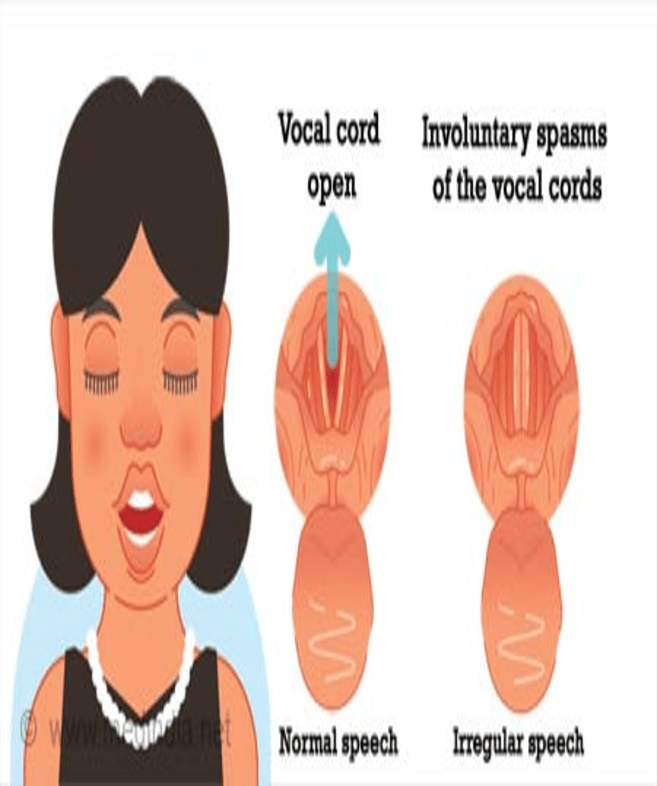
In this case, the muscles affected are those that control the vocal folds, also called vocal cords. Normally, when we speak, these folds open and close in a smooth, finely coordinated way to create vibration and produce sound. But in spasmodic dysphonia, the brain sends abnormal signals that cause these muscles to spasm unpredictably. The result is speech that sounds strained, choked, breathy, or broken.
There are two main subtypes:
- Adductor spasmodic dysphonia: The vocal folds slam together too forcefully, making speech sound tight, strangled, or interrupted.
- Abductor spasmodic dysphonia: The vocal folds snap open suddenly, leading to a weak, breathy, or whisper-like voice.
- Some patients experience a mixed form, where both patterns occur.
The condition usually develops in adulthood, often between the ages of 30 and 50, and once it begins, it tends to persist. While rare, its impact on communication is profound because voice is central to how we connect and express ourselves.
2. How Does the Disorder Affect the Voice We Hear?
To appreciate what spasmodic dysphonia does, imagine trying to play a violin with strings that spasm uncontrollably every few seconds. The music wouldn’t stop entirely, but it would be full of breaks, squeaks, or unexpected silences. That is essentially what happens in the voice of someone with this disorder. Normal speech requires smooth vibration of the vocal folds. When spasms occur, those vibrations are interrupted. A person may be able to say a few words clearly, then suddenly sound strangled, whispery, or as though their voice “cut out.” This irregular pattern distinguishes spasmodic dysphonia from other conditions like chronic laryngitis, where the voice tends to sound consistently hoarse.
For RFK Jr., this has translated into a distinctive rasping, halting style that is now widely recognized. Importantly, the issue is not with his thinking or memory. The disorder stems from motor control in the brain regions responsible for movement coordination, not from the parts responsible for reasoning or cognition.
3. How Is Spasmodic Dysphonia Diagnosed?
Diagnosing spasmodic dysphonia is not straightforward because its symptoms can mimic many other voice problems. People with hoarseness are often first suspected of having laryngitis, vocal fold nodules, reflux damage, or even psychological stress.
That’s why proper diagnosis requires a multidisciplinary approach. Typically:
- An ENT (ear, nose, and throat) specialist examines the vocal folds using techniques like laryngoscopy or stroboscopy, which allow them to see how the folds move during speech.
- A speech-language pathologist evaluates how the voice sounds across different tasks, such as sustained vowels, reading passages, or spontaneous conversation.
- Sometimes, acoustic analysis or video recording of the folds is used to provide objective evidence of spasms.
Because spasmodic dysphonia is rare, many patients initially receive misdiagnoses, leading to years of frustration. Only when the distinct, intermittent pattern of voice breaks is recognized does the correct diagnosis become clear.
4. Do We Know What Causes It?
Despite decades of research, the exact cause remains uncertain. What scientists do know is that spasmodic dysphonia is a form of focal dystonia, and dystonias are linked to abnormal functioning in the brain’s motor control circuits, particularly the basal ganglia, which help regulate movement.
Some theories suggest potential triggers:
- Genetic predisposition in certain families.
- Past viral infections or autoimmune events.
- Trauma to the larynx or nervous system.
- Overuse or strain of the voice.
However, no single factor explains all cases. For many people, the disorder seems to appear out of nowhere. This uncertainty can make it difficult for patients, who often search for answers as to “why me?” But in practice, focus tends to shift toward management rather than cause.
5. What Treatments Exist, and Do They Help?
While there is currently no cure for spasmodic dysphonia, there are effective treatments that can greatly reduce symptoms and allow people to communicate more comfortably.
a) Botulinum Toxin (Botox) Injections
This is the gold standard of treatment. Small doses of botulinum toxin are injected directly into the affected laryngeal muscles. The toxin weakens the overactive muscles just enough to reduce spasms, leading to smoother voice production.
- Relief usually lasts 3 to 6 months.
- The procedure must be repeated periodically.
- Many patients describe the injections as life-changing, restoring their ability to participate in conversations and public speaking.
b) Voice Therapy
Speech-language pathologists can teach patients strategies to maximize clarity, conserve energy, and reduce strain. Techniques may include pacing speech, adjusting pitch, or improving breath support. While therapy alone doesn’t “cure” spasmodic dysphonia, it often enhances the benefit of Botox.
c) Surgery and Experimental Options
In some severe or refractory cases, surgical interventions are considered. These may include procedures to alter vocal fold positioning or implant devices that affect muscle control. Results vary, and such procedures are not as widely available as Botox.
For public figures like RFK Jr., treatment allows them to continue careers that depend heavily on voice, though symptoms never fully disappear.
6. Why Do Voices Fluctuate Day to Day?
One puzzling aspect of spasmodic dysphonia is its variability. A person may sound fairly normal one day and severely strained the next. Factors that influence this include:
- Fatigue: Tired muscles are more prone to spasm.
- Stress or anxiety: Emotional tension often makes the voice worse.
- Physical illness: Colds or respiratory infections add strain to the vocal system.
- Length of speaking: Long speeches demand sustained muscle activity, increasing the likelihood of spasms.
This explains why RFK Jr. might sound clearer in a short interview but more strained during extended Senate testimony. The disorder is dynamic, not fixed.
7. RFK Jr.’s Voice and Public Attention
Because RFK Jr. is a public figure, his voice has been scrutinized far more than it would be for a private citizen. His speeches, interviews, and committee appearances highlight the impact of spasmodic dysphonia, sometimes drawing harsh commentary.
He has acknowledged publicly that the condition began in his 40s and that it has shaped his career in law, activism, and politics. Reports suggest he has tried both standard treatments like Botox and specialized surgical interventions, including experimental devices. His perseverance in continuing to speak publicly despite the disorder reflects both resilience and a need for greater public awareness.
8. Other Health Claims and Clarifications
RFK Jr. has also spoken about past neurological issues, including memory problems and a parasitic infection that once affected his brain. These disclosures have been widely reported, sometimes in sensational terms. It’s important to separate those past medical events from spasmodic dysphonia, which is an entirely distinct condition.
A brain infection in the past may have caused temporary cognitive or neurological symptoms, but spasmodic dysphonia is specifically a focal movement disorder of the voice. Having one does not automatically mean ongoing cognitive decline.
9. Why This Matters, Accuracy and Empathy
The way we talk about visible or audible health conditions matters, especially when the person involved is in public service.
- Medical Accuracy: Mislabeling a voice as simply “weird” or implying it reflects mental fitness spreads misinformation. Only clinical evaluation can establish a diagnosis and impact.
- Reducing Stigma: People with voice disorders often experience embarrassment or withdrawal. Public commentary that mocks or questions their voice can deepen that stigma.
- Practical Solutions: For officials with voice disorders, accommodations like microphones, transcripts, or shorter Q&A sessions help ensure their ideas, not just their delivery, are what people focus on.
10. The Bottom Line
Robert F. Kennedy Jr. has spasmodic dysphonia, a rare neurological disorder that causes involuntary spasms in the vocal folds, producing his distinctive, strained, and halting voice.
- The condition affects speech, not intelligence.
- There is no cure, but treatments like Botox injections, voice therapy, and occasionally surgery help manage symptoms.
- Voice fluctuations are normal and do not indicate cognitive decline.
- Most importantly, how someone sounds should not overshadow the content of their ideas or their capacity to serve.
Public figures like RFK Jr. remind us that health challenges are part of human diversity. By understanding conditions like spasmodic dysphonia, we can replace stigma with empathy and focus on what truly matters, the substance of leadership, not the sound of the voice delivering it.
Conclusion
RFK Jr.’s unusual voice is the result of spasmodic dysphonia, a rare neurological disorder that causes involuntary spasms of the vocal cords. While it has no cure, treatments like Botox injections and voice therapy can help manage symptoms. What’s most important to remember is that this condition doesn’t affect intelligence, leadership, or ability; it only affects how the person sounds. For RFK Jr., his strained and raspy tone may stand out, but it doesn’t define his ideas, work, or influence.
By learning more about spasmodic dysphonia, we not only understand RFK Jr. better but also grow more empathetic toward the millions worldwide who live with voice disorders. At its heart, this is a reminder that a person’s worth is never measured by the sound of their voice, but by the strength of their words.